
Reviewed · WORKSHOPS
Arabic Calligraphy Workshop Marrakech
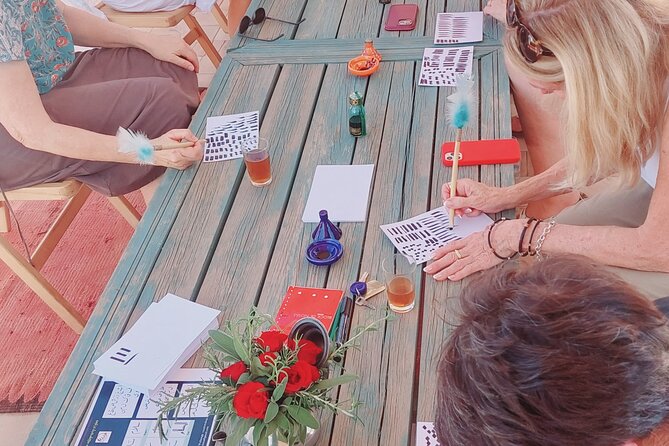
Arabic calligraphy is more than pretty writing. In this Marrakech workshop, you learn how a bamboo qalam pen turns simple strokes into letters, patterns, and meaning. The class covers the Arabic alphabet, pen technique, basic forms, and several styles before you create your own work.
I like the hands-on practice and the small maximum of 10 people. I also like the personal touch: the master calligrapher writes your name, and you choose expressions for bookmarks, such as happiness, love, wisdom, or life is beautiful.
The main consideration is time. Two hours gives you a satisfying introduction, not mastery. If you already study Arabic, the lesson may feel basic in places, though the correct pen grip and stroke technique can still be useful.
In This Review
- Key points to know before booking
- What the Marrakech calligraphy class is really about
- Meeting at Marrakech Museum at 3 pm
- Step one: learning the tools and the Arabic alphabet
- Step two: circles, lines, curves, and pen control
- Step three: styles, composition, and your own writing
- The personalized name and bookmark keepsakes
- The teachers: Zizi, Houcine, Essaid, and Said
- Is $63.88 a fair price for two hours?
- Who will enjoy this workshop most?
- Booking, cancellation, and timing tips
- Should you book Arabic Calligraphy Workshop Marrakech?
- FAQ
- Where does the Arabic calligraphy workshop begin?
- What time does the workshop start?
- How long does the workshop last?
- Where does the activity end?
- What will I learn during the class?
- Will I practice with a bamboo qalam pen?
- Will my name be written in Arabic?
- Do I receive bookmarks?
- How many people can join the workshop?
- Can I cancel for a full refund?
Key points to know before booking
- Your name becomes a keepsake: A calligrapher writes your name beautifully, and you receive bookmarks with expressions of your choice.
- The bamboo qalam is central: You practice with the traditional pen and learn why holding it correctly affects every letter.
- The class is capped at 10 people: A small group gives you a better chance to receive help with strokes and letter shapes.
- The lesson meets at Marrakech Museum: The starting point is Place Ben Youssef, in a central part of Marrakech.
- The focus is practical: You study tools, letters, sounds, styles, and composition, then spend much of the session writing.
- The schedule is simple: The workshop starts at 3 pm, lasts about two hours, and ends where it began.
What the Marrakech calligraphy class is really about
This experience works because it gives you a direct way into an art form that can seem mysterious at first. Arabic calligraphy is not simply handwriting in another alphabet. The angle of the pen, the width of the cut nib, the pressure of your hand, and the space between letters all affect the final shape.
You begin with the basic idea behind Arabic calligraphy and its place in Arabic culture. The introduction is brief, but it gives your practice some meaning. Instead of copying marks without context, you learn why the letters have certain forms and how calligraphy developed into a highly refined art.
The lesson is suitable for adults and children, according to the activity information. You do not need to arrive already able to read Arabic. One class description specifically includes learning the letters and their sounds, so you can approach the workshop as both a creative activity and a gentle introduction to the Arabic alphabet.
That combination makes this a good break from Marrakech sightseeing. After the noise, color, and movement of the medina, sitting down with ink and paper asks you to slow your hands and pay attention. It is a quiet kind of cultural experience, with a result you can carry home.
More Marrakech trips worth a second look
- Marrakech: Moroccan Cooking Class with Pickup
★ 4.6 · 1,862 reviews - Marrakech: Traditional Moroccan Cooking Class & Market Visit
★ 4.8 · 1,861 reviews - Marrakesh: Moroccan Dishes Cooking Class with a Local Chef
★ 5.0 · 1,615 reviews
Meeting at Marrakech Museum at 3 pm
The workshop begins at Marrakech Museum, Place Ben Youssef, Marrakech 40000. You return to the same meeting point at the end, so you do not need to arrange a separate ride back from an unfamiliar part of town.
The location is useful if you are already visiting the Ben Youssef area. Confirm the exact meeting instructions when you book, then allow enough time to reach the museum. The published start time is 3 pm, and the class lasts about two hours.
This is a mobile-ticket activity, which keeps the booking side simple. You receive confirmation at the time of booking. The workshop is near public transportation, but no private transport or hotel pickup is listed, so plan to make your own way to Place Ben Youssef.
The setting matters. A class held near Marrakech Museum feels connected to the city’s artistic traditions rather than placed in an anonymous meeting room. The information does not promise a museum visit as part of the class, so think of the museum as the meeting location, not an extra guided attraction.
Step one: learning the tools and the Arabic alphabet
The first part introduces the main tools, especially the pen and ink. The traditional bamboo qalam is an important part of the experience. You learn how to use it, rather than treating it like an ordinary ballpoint pen.
Pen position is one of the useful details here. A participant who had studied Arabic for years found that the class finally clarified how to hold the pen properly. That is a good reminder that speaking or reading Arabic does not automatically teach you calligraphy. Writing letters artistically follows its own rules.
Next comes the Arabic alphabet. The instructor shows you how letters are formed and explains their sounds. Some Arabic letters change shape depending on where they appear in a word, so the lesson can give you a first look at a writing system that behaves differently from the Roman alphabet.
Do not expect a full language class. The aim is to understand the letters as shapes and practice their construction. Still, even a short explanation can change the way you look at Arabic signs around Marrakech. You begin to notice the balance, repeated curves, and measured spacing instead of seeing only a wall of unfamiliar writing.
Step two: circles, lines, curves, and pen control
Before you write full words, you work on basic forms. Circles, straight lines, and curves may sound simple, but they are the building blocks of the script. The exercise gives you a feel for how much ink the pen lays down and how a small change in angle affects the line.
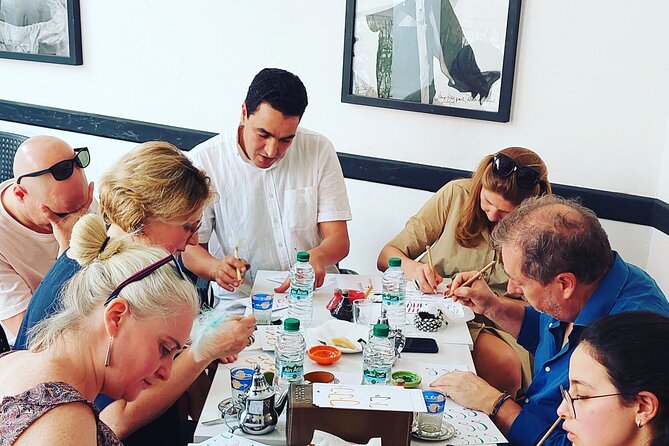
This is where the class becomes genuinely hands-on. You are not just watching an artist produce a perfect page. You put pen to paper and repeat the movements yourself. The instructor can point out problems with pressure, direction, or spacing while you still have time to correct them.
Expect your first attempts to look less polished than the teacher’s work. That is normal. Arabic calligraphy rewards control and repetition, and two hours cannot replace long practice. The value lies in seeing how the shapes are made and leaving with a better understanding of the craft.
The pace should suit most beginners because the workshop moves from simple strokes to letters and then to composition. If you are attending with children, the practical format may hold their attention better than a long talk. The class is also suitable for adults who want a creative activity but do not consider themselves artists.
A different kind of day out, same corner of Morocco:
- Marrakech: Agafay Desert Sunset, Camel Ride, and Dinner Show
★ 4.6 · 35,119 reviews - From Marrakech: Ouzoud Waterfalls Guided Hike and Boat Trip
★ 4.7 · 33,630 reviews - Marrakech: Agafay Desert Quad & Camel Rides with Dinner Show
★ 4.8 · 27,382 reviews - Marrakech: Agafay Desert Quad Biking Tour with Dinner-Show
★ 4.8 · 16,569 reviews
Step three: styles, composition, and your own writing
Once you have the basic strokes and letters, the class looks at composition and different styles of Arabic calligraphy. The information does not name each style, so you should not book this expecting a detailed survey of every major school of script.
What you do get is a sense that Arabic calligraphy is not one fixed look. Some writing is compact and formal, while other work gives the letters more sweep and decorative movement. The teacher demonstrates how letters can be arranged as a balanced design, not simply placed in a straight line.
Composition is especially useful for anyone interested in design, photography, tattoos, handmade cards, or decorative art. You see how a short word or phrase can become a visual object. This also helps explain why a small number of Arabic letters can fill a page with such presence.
The practical portion takes up much of the experience. That is a strength. A short cultural talk would be easy to forget, but your own uneven lines and repeated letter forms give the lesson a physical memory. You may not leave writing like a master, but you will understand the work behind the finished examples.
The personalized name and bookmark keepsakes
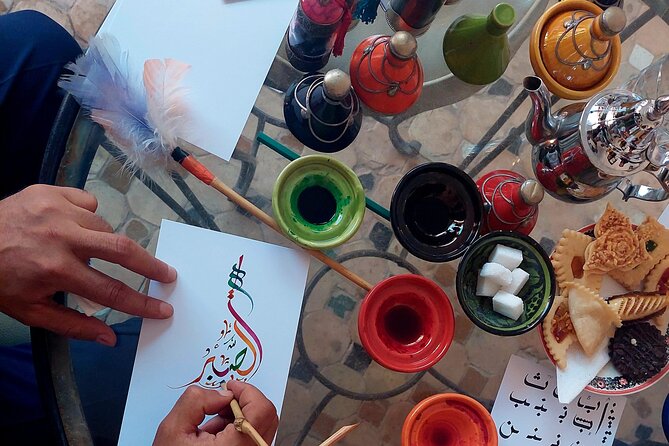
A highlight is having your name written in Arabic by the calligraphy master. This is different from simply buying a souvenir in a shop because the name is made for you during the workshop. It also gives you a clear example of how the letters connect and how the artist handles the pen.
You can also leave with bookmarks bearing expressions you choose. Suggested phrases include happiness, life is beautiful, live your life, wisdom, fidelity, love, and dream. If you are buying this as a shared activity, choosing phrases for one another adds a small personal decision to the class.
The name and bookmarks are meaningful without taking up much luggage space. They also make the workshop a sensible choice for someone who wants a Marrakech souvenir with a direct connection to Arabic art.
The exact number of bookmarks and the precise materials are not specified, so I would not book it expecting a large finished portfolio. Think of the take-home pieces as personal mementos, while the real activity is learning the strokes and making your own attempts.
The teachers: Zizi, Houcine, Essaid, and Said
The experience provider is ZIZI ESSAID, and the teaching names connected with the workshop include Zizi, Houcine, Essaid, and Said. The feedback describes the instructors as patient, encouraging, friendly, hospitable, and highly skilled at showing the writing technique.
Houcine is praised as an artist, while Zizi is singled out for helping with pen technique. Houcine and Essaid are also described as friendly and well informed about the art and its different styles. Since more than one teacher name appears in the available information, the person leading your particular class may vary.
That is worth keeping in mind when booking. You are signing up for the workshop provided by the same team, but you should not assume that one named instructor will definitely teach every session.
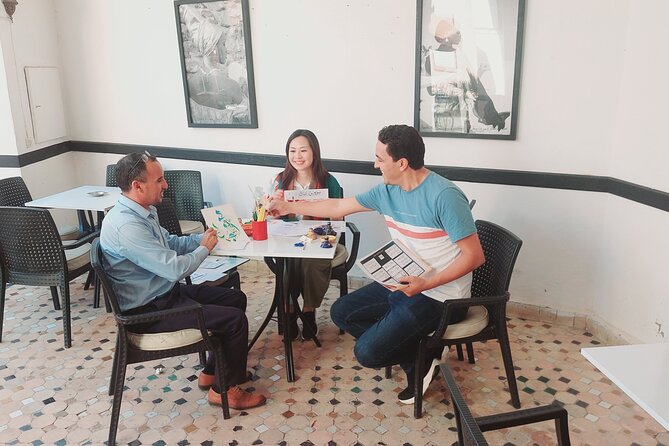
The teaching style sounds especially helpful for beginners. Calligraphy can feel intimidating when the instructor’s work looks perfect. A patient teacher makes it easier to try, make mistakes, and try again. The class seems designed to encourage practice rather than judge the quality of your first page.
One Spanish-language account also describes an inviting workshop atmosphere with mint tea and pastries. These refreshments add a pleasant Moroccan touch, though they should be viewed as part of the reported workshop atmosphere rather than a guaranteed feature to plan your meal around.
Is $63.88 a fair price for two hours?
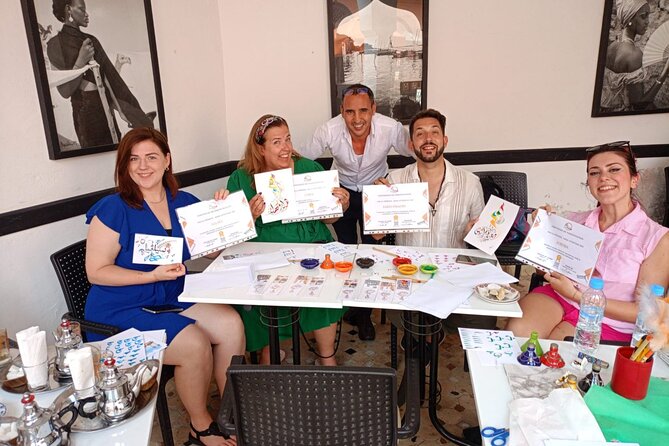
At $63.88 per person, this is not the cheapest short activity in Marrakech. The value depends on what you want from the afternoon.
You are paying for more than a demonstration. The class includes instruction in tools, pen handling, letter forms, sounds, styles, and composition, along with time to practice. You also receive a personalized name and bookmarks with selected expressions. For someone who values a guided cultural activity and a made-for-you souvenir, the price can be reasonable.
The maximum group size of 10 helps the calculation. A class of that size is still social, but it offers a better chance of receiving individual help than a large public demonstration. One especially favorable situation would be a very small group, though you should not count on having the workshop to yourself.
The price may feel high if you mainly want a quick name written in Arabic. In that case, the workshop asks you to pay for the teaching and the process, not only the final piece. It is also not a full-day art course, so people seeking serious technical training may want a longer program.
I would compare it with the cost of another two-hour guided activity in Marrakech, then ask how much you value participation. If you want to sit, listen, practice, and make something personal, the offer is stronger than a simple souvenir purchase.
Who will enjoy this workshop most?
I would recommend it to first-time visitors who want a calm cultural activity between sightseeing stops. It also suits couples, families, and solo participants. The mix of history, alphabet instruction, and practical work gives different age groups something to follow.
Arabic-language students may get extra value from the lesson. Even if you can already read or speak some Arabic, calligraphy introduces a separate skill. The point about pen grip is important: basic writing ability does not mean you already know how to use a bamboo qalam.
Art-minded visitors should enjoy the focus on line, balance, and composition. You do not need formal training. The workshop is about learning the process, not producing a gallery-ready piece in one sitting.
I would be more cautious if you want a fast, highly polished souvenir or an advanced course in a particular calligraphic style. The session is introductory and lasts around two hours. It gives you a taste and some practice, not a professional qualification.
The practical details are friendly for most people. Service animals are allowed, most people can participate, and the class is near public transportation. The group limit is 10, which is helpful for anyone who wants a more personal lesson.
Booking, cancellation, and timing tips
The experience is usually booked about 38 days ahead, which suggests that you should reserve before your Marrakech visit if your schedule is tight. The published start time is 3 pm, so it can fit after a morning tour or before an evening meal.
Free cancellation is available if you cancel at least 24 hours before the local start time. Cancellations or changes made inside that window are not accepted for a refund. That policy is straightforward, but check your plans before booking because a last-minute change can cost the full amount.
Arrive ready to write. The most useful attitude is patience. Your lines may wobble, and your letters may not match the teacher’s examples at first. That is part of the point. Pay attention to how the pen is held, ask for corrections, and use the practice time rather than waiting for the instructor to do all the beautiful work.
Should you book Arabic Calligraphy Workshop Marrakech?
Book it if you want a small-scale Marrakech activity that connects you with Arabic writing through your own hands. The strongest reasons are the practical lesson, the chance to learn the Arabic alphabet and pen technique, and the personalized name and bookmarks.
At $63.88, it is best viewed as a guided art class with keepsakes, not a quick attraction or a bargain souvenir stop. The two-hour format is short, but it is long enough to learn the basic forms, practice letters, and understand why the bamboo qalam matters.
I would choose it for couples, families, Arabic-language students, and anyone who enjoys making something rather than only looking at monuments. Skip it if you want advanced calligraphy training or a packed sightseeing tour. For a quiet, personal afternoon near Marrakech Museum, this is a thoughtful choice.
FAQ
Where does the Arabic calligraphy workshop begin?
It begins at Marrakech Museum, Place Ben Youssef, Marrakech 40000, Morocco.
What time does the workshop start?
The published start time is 3 pm.
How long does the workshop last?
The experience lasts approximately two hours.
Where does the activity end?
It ends back at the meeting point at Marrakech Museum.
What will I learn during the class?
You learn about Arabic calligraphy, the basic tools, circles, straight lines, curves, Arabic letters, letter sounds, composition, and different calligraphy styles.
Will I practice with a bamboo qalam pen?
Yes. The workshop includes practice with the bamboo qalam pen used for Arabic calligraphy.
Will my name be written in Arabic?
Yes. The master calligrapher writes your name beautifully as part of the experience.
Do I receive bookmarks?
Yes. You leave with bookmarks bearing expressions you choose, such as happiness, love, wisdom, dream, or other phrases.
How many people can join the workshop?
The maximum group size is 10 people.
Can I cancel for a full refund?
Yes, if you cancel at least 24 hours before the experience start time. Cancellations or changes made less than 24 hours before the start are not accepted for a refund.
Recently reviewed around Marrakech
- 4-Days Marrakech to Marrakech Désert Tour★ 5.0 · 17 reviews
- Camel ride at sunset in Marrakech palm grove★ 5.0 · 17 reviews
- Agafay camel ride★ 5.0 · 20 reviews
- Camel riding in marrakech★ 4.5 · 17 reviews
- Marrakech to Atlas Mountains and 4 Valleys Day Trip★ 5.0 · 17 reviews
- Agafay Desert Adventure, Culture, and Relaxation, From Marrakech★ 5.0 · 25 reviews
- Quad excursion to the Agafay desert near Marrakech★ 5.0 · 44 reviews
- Camel ride and dinner Agafay desert★ 5.0 · 25 reviews
Workshops, compared.
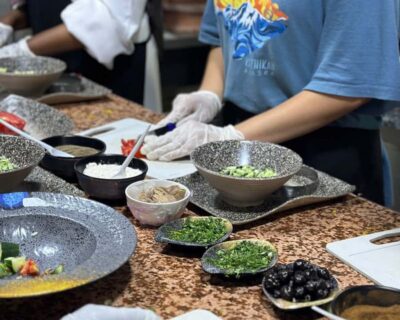
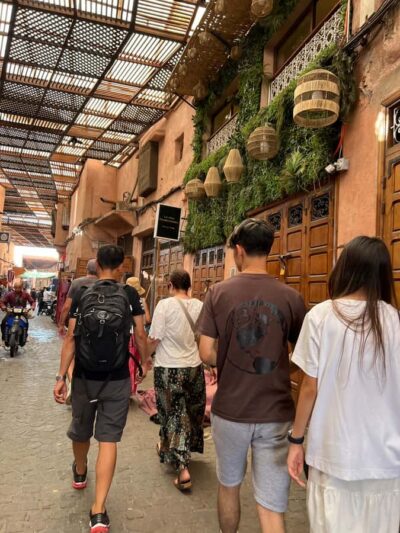
Traditional Moroccan Cooking Class & Market Visit
Read our review →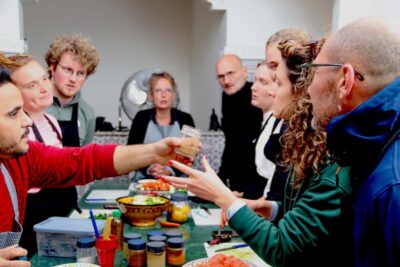
Moroccan Dishes Cooking Class with a Local Chef
Read our review →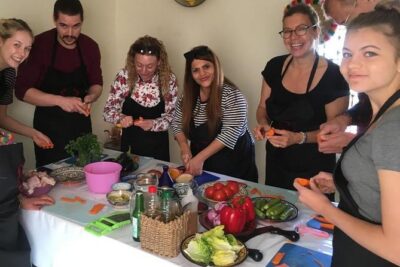
Moroccan Cooking Class & Marrakech Market Visit with Chef Khmisa
Read our review →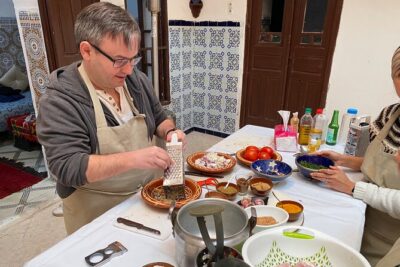
Half-Day Cooking Class with Local Chef Laila in Marrakech
Read our review →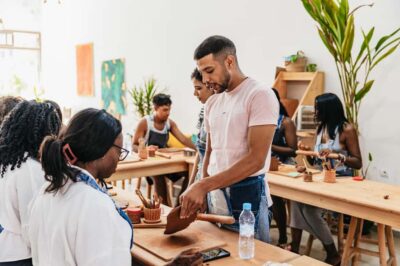
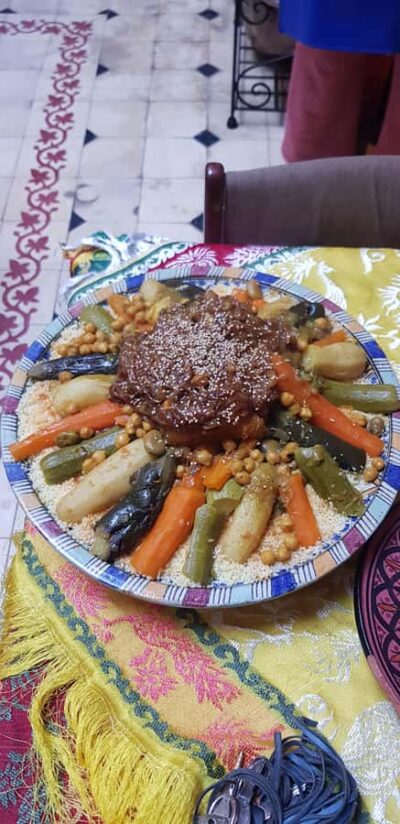
Browse the lists this tour appears in