
Reviewed · MEDINA & SOUK WALKS
Marrakech: Guided Medina History & Culture Tour
Marrakech’s medina makes more sense when you connect its grand monuments with the ordinary streets between them. This four-hour walk begins at Koutoubia Mosque, passes through the old Jewish quarter and Bahia Palace, then leads into residential lanes, craft souks, Ben Youssef Madrasa, and ends at Jemaa el-Fnaa.
I like the way this tour combines major sights with everyday neighborhoods, rather than keeping you on the usual postcard route. I also like that Youssef has been praised for clear English, strong knowledge of Moroccan history, useful shopping advice, and taking his time with photographs and questions.
The main drawback is the price: $65 per person is fair for a private or small-group outing with two included entry tickets, but it is not a bargain if you prefer to wander alone. Four hours on foot also calls for good shoes and a sensible pace.
In This Review
- Key points to know before booking
- Starting beneath Koutoubia Mosque
- The Mellah and its fresh produce market
- Bahia Palace, tilework, and shaded courtyards
- Local lanes away from the main tourist track
- Ben Youssef Madrasa and the old school system
- Craft workshops in the working souks
- Rahba Kedima and the spice square
- Souk Semmarine and Moroccan design
- Ending at Jemaa el-Fnaa
- Is $65 a fair price?
- Who should book this medina walk?
- Should you book this tour?
- FAQ
- Where does the tour meet?
- How long does the tour last?
- Which languages are available?
- Are admission tickets included?
- Does the tour visit inside Koutoubia Mosque?
- Is the tour suitable for wheelchair users?
Key points to know before booking
- Koutoubia sets the historical frame: Begin beside Marrakech’s best-known mosque and learn about the city’s first road and entrance gate.
- Bahia Palace gets proper attention: Spend about 45 minutes among tiled courtyards, gardens, fountains, carved stucco, and cedar ceilings.
- The route leaves the tourist lanes: Walk through local residential areas and a produce market where daily shopping carries on.
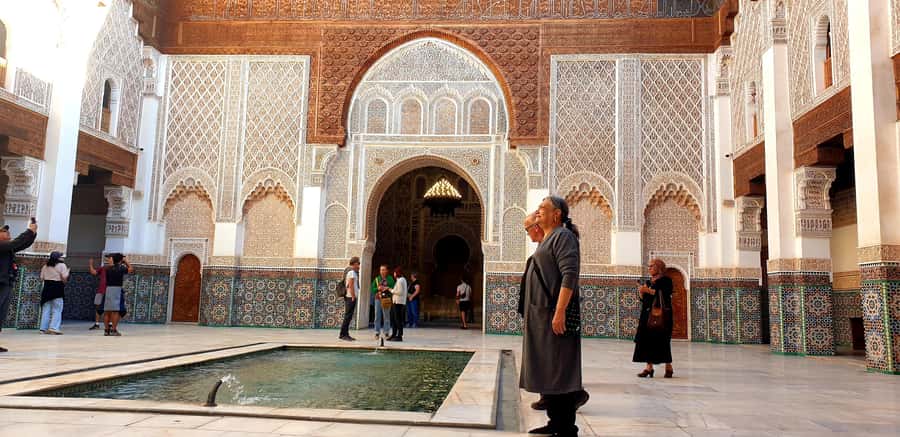
- Ben Youssef Madrasa explains more than architecture: See the prayer hall, ablutions room, and former students’ quarters while learning about traditional education.
- Crafts are part of the route: Watch work connected with leather, wood, silver, bronze, and copper before reaching the spice square and Souk Semmarine.
- Jemaa el-Fnaa is the finale: Finish in Marrakech’s famous square, with street performers, games, and the city’s constant motion.
Starting beneath Koutoubia Mosque
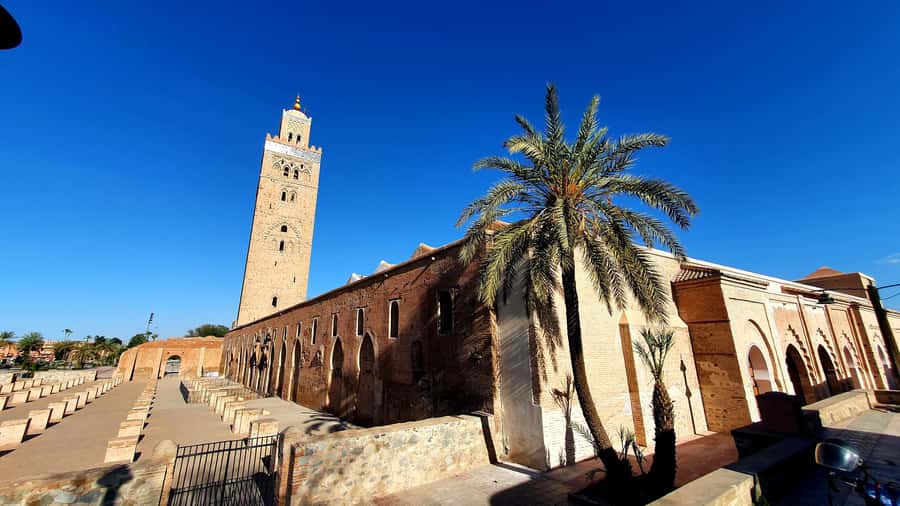
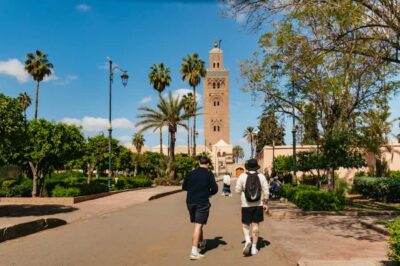
Your meeting point is the small white mausoleum called Kubba Fatima Zohra, at the foot of the Koutoubia Mosque tower on Mohamed V Boulevard. Look for a guide wearing an official badge with a blue ribbon.
This is a smart place to begin. Koutoubia is one of Marrakech’s clearest landmarks, so it gives you an easy reference point before the lanes become more confusing. The opening 15 minutes take in the mosque from outside, its surrounding gardens, scenic views, and the story of Marrakech’s early development.
You also see the city’s first road and an old entrance gate. Those details help turn the medina from a maze into a place with a layout and a past. You will not go inside Koutoubia Mosque, and the stop is mainly for exterior history and orientation.
The walk then continues for about 10 minutes. That short transfer is useful because the tour moves quickly from a royal and religious landmark into a district tied to another part of Morocco’s past.
More Medina Walks in Marrakech
- Marrakech: Bahia Palace, Saadian Tombs, Souk and Medina Tour
★ 4.7 · 4,974 reviews - Marrakech: Colorful Medina Souks Guided Walking Tour
★ 4.7 · 2,470 reviews - Marrakech: Saadian Tombs & Bahia Palace, Medina Guided Tour
★ 4.6 · 1,989 reviews
The Mellah and its fresh produce market
The Mellah, Marrakech’s old Jewish quarter, gives the morning a welcome change of subject. You stop for about 15 minutes to learn about Morocco’s Jewish heritage and visit a busy fresh produce market.
I value this part because it shows that Marrakech cannot be reduced to palaces, mosques, and shopping. The market brings you into ordinary city life, with food being bought and sold for local households rather than arranged for photographs.
The stop is brief, so do not expect a long market tour or a separate food tasting. It works best as a quick look at the neighborhood and a chance to understand how religious communities and commercial districts shaped the old city.
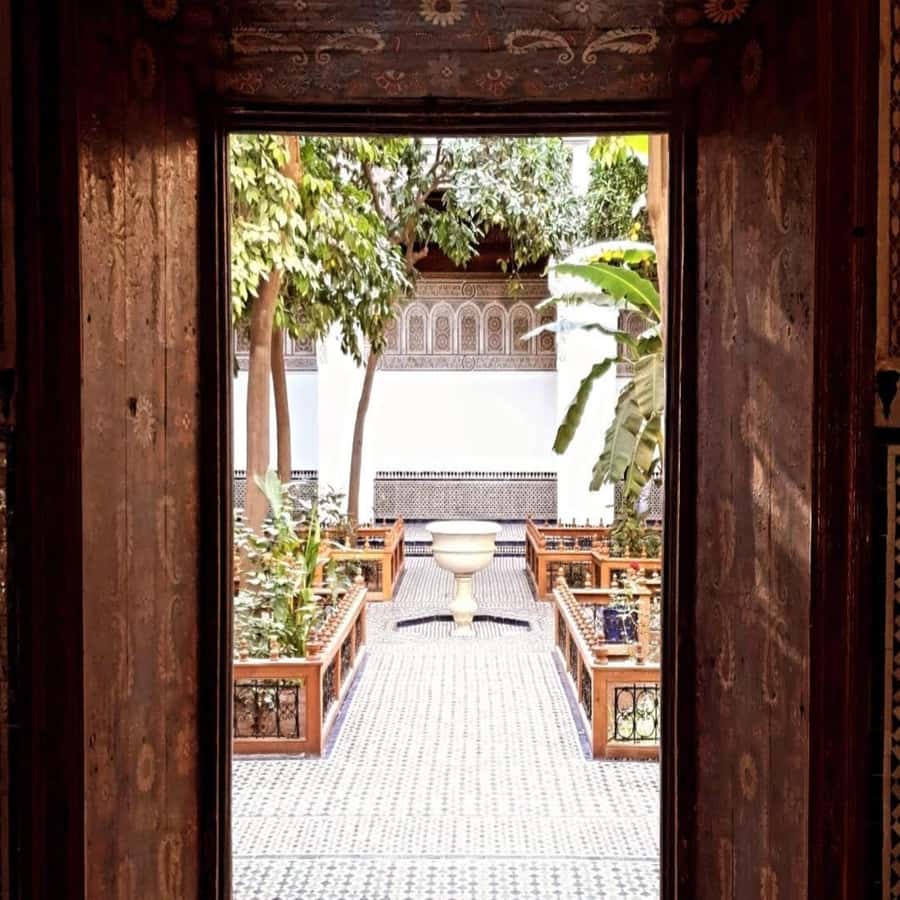
Bahia Palace, tilework, and shaded courtyards
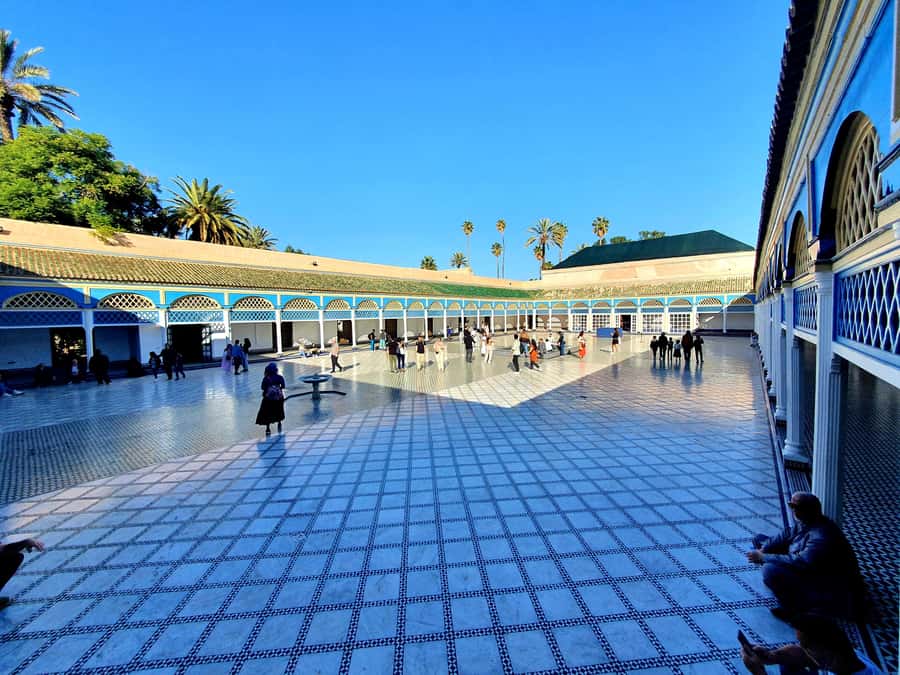
Bahia Palace is the first major interior visit, with about 45 minutes for photographs, sightseeing, and a guided explanation. Skip-the-line admission is included, which matters at a popular sight where waiting can cut into a short morning.
The palace is a chain of Andalusian-style riads, gardens, patios, fountains, and reception rooms. Instead of viewing one grand exterior, you move through a series of enclosed spaces. Each one brings a different pattern or material into view.
Look for zellij mosaics arranged in precise geometric designs, carved stucco with Arabic inscriptions, cedar ceilings, and gates decorated with arabesques. A guide adds value here because the workmanship can look like a blur of color when you see it without context.
The palace is also a good example of how Moroccan design uses repeated detail to create calm and order. Give yourself time to look down at the tile patterns, then up at the ceilings and carved surfaces. The rooms are the reason to come, but the transitions between courtyards are part of the pleasure.
The 20-minute walk after Bahia Palace is one of the tour’s more useful sections. You head away from the formal monuments and into old residential streets. This is where the route starts to feel less like a list of sights and more like a lesson in how the medina functions.
Local lanes away from the main tourist track
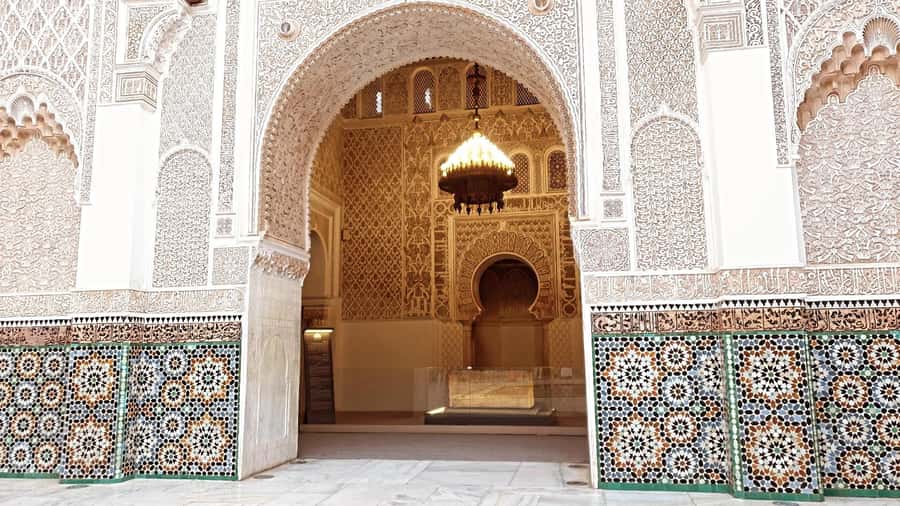
The tour takes you through typical residential neighborhoods where locals live and do their everyday shopping. You may find the streets narrower and less polished than the palace areas, but that is the point.
This section gives you a look at the medina as a home, not just a shopping district. Pay attention to the doors, small shops, foot traffic, and the way daily errands fit into old streets. You are not simply crossing from one attraction to another. You are seeing the setting in which those attractions still make sense.
A guide is especially useful here. It is easy to lose your bearings in Marrakech, and a local guide can lead you through streets you might not choose alone. French and English are offered, and Youssef has been singled out for explaining local customs clearly and showing places many people would not find by themselves.
The route does require steady walking. Wheelchair users should not book this outing, and everyone should wear comfortable shoes. Bottled water is included, either two small bottles or one large bottle per person, though you should still plan for a warm day sensibly.
More Marrakech trips worth a second look
- Marrakech Historical and Cultural Tour – Half Day City Tour
★ 4.5 · 1,180 reviews - Marrakech: Historical Discovery Tour
★ 4.1 · 87 reviews - 3 Days Desert Tour From Marrakech To Merzouga Désert And World Heritage Kasbah
★ 4.0 · 46 reviews - Marrakech: Day Trip to the Beautiful and Historic Essaouira
★ 4.3 · 39 reviews
Ben Youssef Madrasa and the old school system
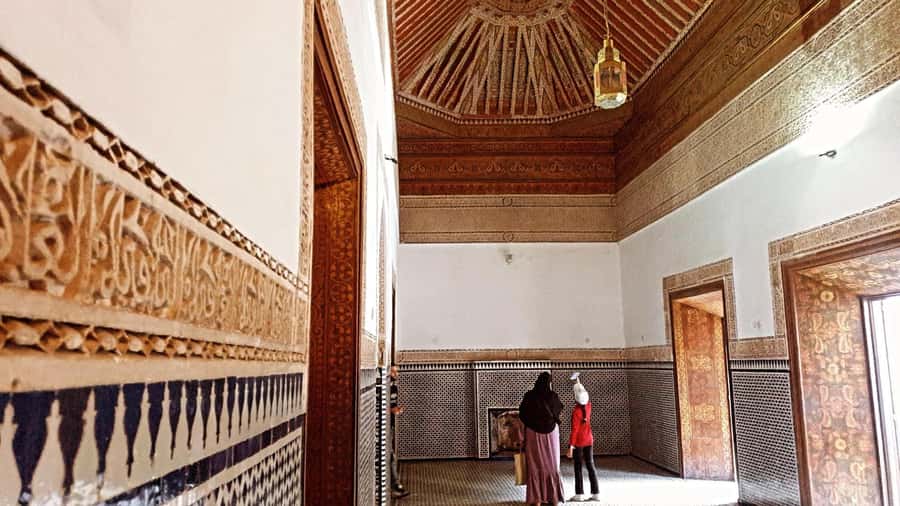
The next major stop is Ben Youssef Madrasa, with about 45 minutes inside. Skip-the-line entry is included here as well, so you can spend your time looking rather than waiting.
This former religious school is a jewel of Arabo-Islamic art, but the visit is not only about decoration. You see the prayer hall, ablutions room, and students’ quarters while learning about Muslim practice and Morocco’s traditional education system.
The students’ rooms are especially helpful for understanding the building’s purpose. The madrasa was not designed as a palace. It was a place for study, prayer, and communal life. That difference gives the ornament a stronger meaning.
Look for the careful balance of tile, carved stucco, wood, and open space. The prayer hall and ablutions area also show how religious use shaped the building. If you only have time to photograph the courtyard, you will miss much of what makes the madrasa worth visiting.
The schedule allows 45 minutes, enough for a guided visit without making the stop feel rushed. It is a good contrast with Bahia Palace: Bahia shows elite domestic and ceremonial life, while Ben Youssef brings education and religious practice into view.
Craft workshops in the working souks
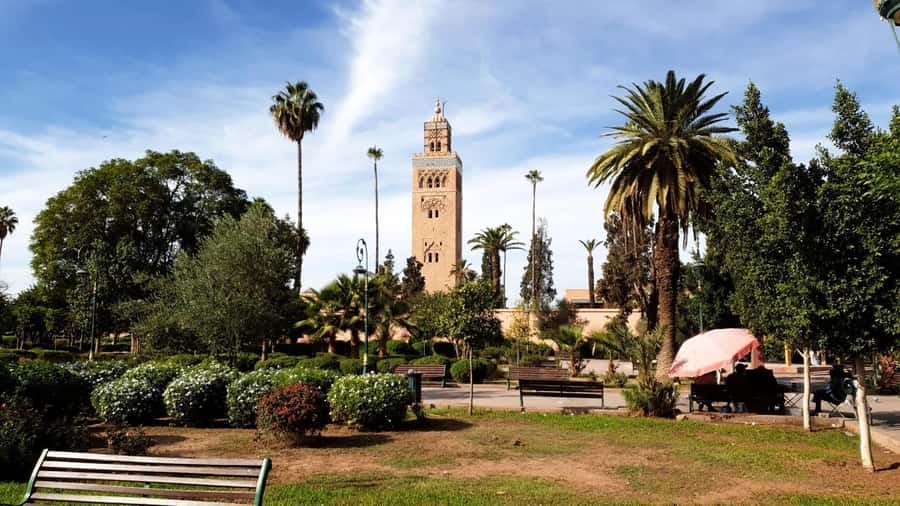
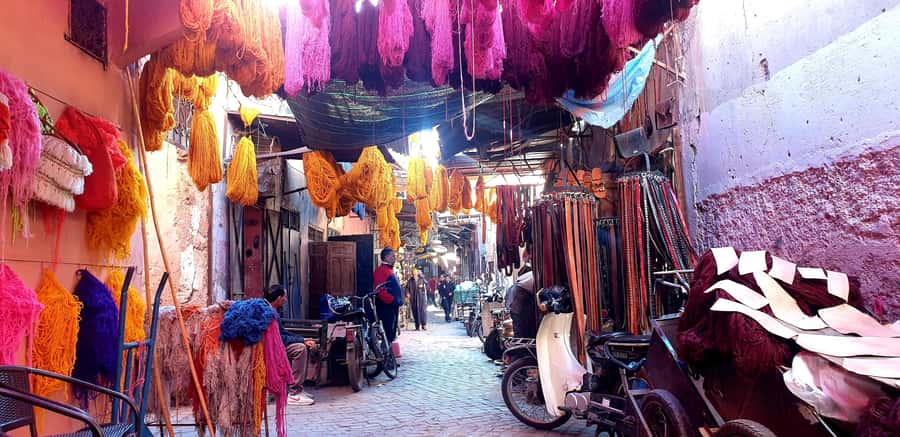
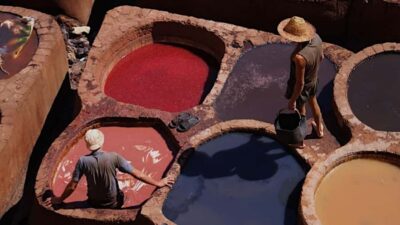
After the madrasa, you enter the more active souks, including the leather market area. This section lasts about 15 minutes and focuses on local crafts and the organization of trade.
You may see workshops and skilled craftspeople at work with leather, wood, silver, bronze, and copper. The guide explains how the markets are grouped by trade and how valuable materials can be auctioned to the highest bidder.
That organization is worth noticing. The souks are not simply a jumble of stalls. Different materials and skills have their own places, and the route gives you a way to read the commercial logic behind the noise and movement.
This is also the point where shopping pressure can become part of the experience. The tour includes time to see products and workshops, but purchases are not required. If you are interested in buying, Youssef has offered practical advice on where to shop and what to look for. Still, keep your own budget and judgment in charge.
The craft stop is short, so think of it as an introduction rather than a full workshop visit. You will get more from it if you watch the process and ask questions instead of treating each stall as a sales stop.
Rahba Kedima and the spice square
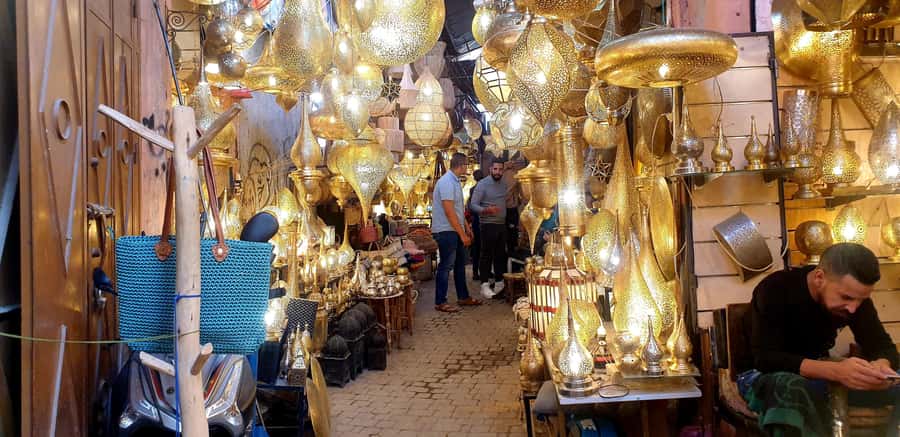
The route continues to Rahba Kedima, the old spice square, for about 15 minutes. Here you have a break, some free time, scenic views, regional food, and a chance to see workshop activity.
The square adds color and scent to a tour that has already covered tilework, architecture, religious study, and metalwork. Spices are central to the visual character of Moroccan markets, but this stop is not presented as a formal cooking class or tasting.
Use the pause to look around, take photographs, and ask about the goods in front of you. The market can be a useful place to test your ability to compare prices and quality before reaching the larger shopping streets. If you want to buy something, ask clearly about the price and take time before agreeing.
The 15-minute limit means you should not count on a long meal here. It is a short break within a walking tour, not a food-focused excursion.
Souk Semmarine and Moroccan design
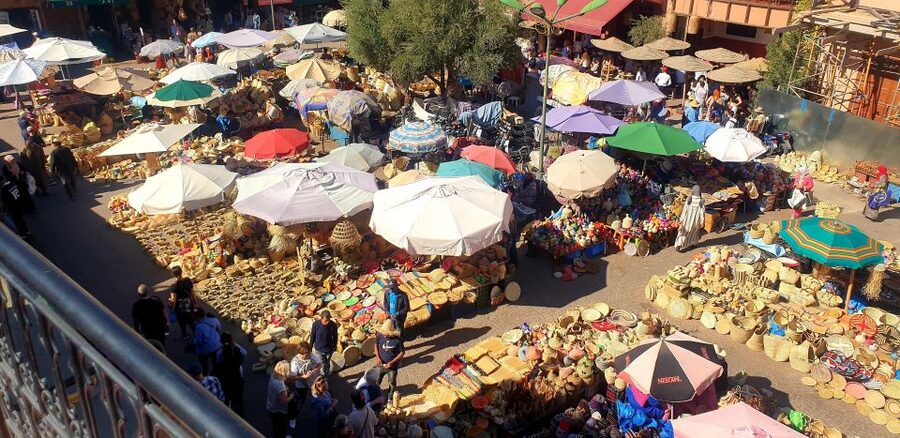
The final shopping area is Souk Semmarine, a major showcase for Moroccan artisans. You spend about 15 minutes visiting arts and crafts stalls before walking five minutes to Jemaa el-Fnaa.
This souk is a fitting link between old trade and modern design. Moroccan crafts have long drawn artists and designers looking for ideas, and the route gives you a chance to see why. Patterns, metalwork, leather goods, woodwork, and household objects carry the visual language introduced earlier at Bahia Palace and Ben Youssef.
I would treat this as a chance to learn what you like, not as a promise that every item is a good purchase. The guide can help explain materials and point out respected work, but shopping is optional. A short stop is enough to browse and orient yourself, though serious shoppers may want to return later with more time.
Ending at Jemaa el-Fnaa
The tour finishes at Jemaa el-Fnaa, Marrakech’s best-known public square. The final 10 minutes include a photo stop, sightseeing, and traditional dance performance.
This is a lively ending because the square gathers many of the city’s public pleasures in one place: street artists, games, food activity, and people watching. It also gives you a clear place to continue on your own after the guide leaves.
Do not expect the final stop to be a full evening program. Ten minutes is enough for an introduction, a few photographs, and basic orientation. If the square catches your interest, you can stay longer afterward, now with a better sense of how it fits into the medina.
Ending here also makes practical sense. After four hours of walking, you can choose to keep exploring, shop nearby, or head back toward your accommodation. The tour does not return you to Koutoubia.
Is $65 a fair price?
At $65 per person, the value depends on how much help you want inside Marrakech’s old city. The fee includes a guide, skip-the-line entry to Bahia Palace, skip-the-line entry to Ben Youssef Madrasa, and bottled water. You are paying for interpretation and navigation as much as admission.
For a first day in Marrakech, I think the price is easier to justify. You cover the city’s major sights, learn how the medina is arranged, and get a look at local streets that can be hard to approach with confidence. The guide can also help with shopping decisions and give you bearings for the rest of your stay.
The value is less clear if you are a confident independent walker who already plans to visit both monuments. In that case, the tour’s main benefit is the local explanation, the route through residential districts, and the time saved at ticket lines.
The outing can run longer than four hours. One guest said the group spent more than five hours with Youssef, so keep your later plans flexible if you want time for questions, photographs, or extra stops. That longer pace may be a plus for curious visitors, but it could frustrate you if you have a tight schedule.
Who should book this medina walk?
I would recommend it to first-time visitors who want context before exploring alone. It suits people who enjoy architecture, local customs, religious history, food markets, and craft traditions in one outing.
It is also a strong choice if you want to see more than the famous monuments. The residential lanes and trade areas are a real part of the route, not just a quick crossing between ticketed sights.
Families with older children may like the variety, since the tour changes setting often. Independent shoppers should see the shopping stops as orientation, then return later if they want a slower look.
You should think twice if long walks, uneven streets, or crowded markets are difficult for you. The activity is not suitable for wheelchair users, and comfortable footwear is essential.
The guide matters a great deal. Youssef, also spelled Yousef or Yusef in some references, has received especially strong praise for clear English, warmth, detailed explanations, patience, photographs, and useful buying tips. Other guides may lead the tour, so confirm your language preference when booking. English and French are available, and private groups can be arranged.
Free cancellation is available up to 24 hours before the start, and you can reserve now and pay later. Those terms are useful if your Marrakech plans are still shifting.
Should you book this tour?
Book it if you want a well-shaped introduction to Marrakech that joins Bahia Palace and Ben Youssef Madrasa with the places in between. The best part is not any single monument. It is the way the route moves from Koutoubia and the Mellah through local streets, workshops, spice stalls, and finally Jemaa el-Fnaa.
I would schedule it early in your stay, when help with directions, customs, and shopping is most useful. Choose comfortable shoes, leave room in your schedule, and treat the souks as places to observe before you buy.
Skip it if you prefer a slow solo wander and do not need explanations. For most first-time visitors who want both the headline sights and a look at daily medina life, $65 is a reasonable price for four hours of guidance, access, and orientation.
FAQ
Where does the tour meet?
Meet at Kubba Fatima Zohra, the small white mausoleum at the foot of Koutoubia Mosque tower on Mohamed V Boulevard. The guide wears an official badge with a blue ribbon.
How long does the tour last?
The scheduled duration is four hours. The time can run longer if you spend extra time on questions, photographs, or stops.
Which languages are available?
The tour is offered with a live guide in English or French.
Are admission tickets included?
Yes. Skip-the-line entry to Bahia Palace and Ben Youssef Madrasa is included.
Does the tour visit inside Koutoubia Mosque?
No. The Koutoubia stop is an exterior visit with sightseeing, history, and views around the mosque and gardens.
Is the tour suitable for wheelchair users?
No. The activity is not suitable for wheelchair users. Comfortable shoes are recommended for all participants.
Recently reviewed around Marrakech
- 4-Days Marrakech to Marrakech Désert Tour★ 5.0 · 17 reviews
- Camel ride at sunset in Marrakech palm grove★ 5.0 · 17 reviews
- Agafay camel ride★ 5.0 · 20 reviews
- Camel riding in marrakech★ 4.5 · 17 reviews
- Marrakech to Atlas Mountains and 4 Valleys Day Trip★ 5.0 · 17 reviews
- Agafay Desert Adventure, Culture, and Relaxation, From Marrakech★ 5.0 · 25 reviews
- Quad excursion to the Agafay desert near Marrakech★ 5.0 · 44 reviews
- Camel ride and dinner Agafay desert★ 5.0 · 25 reviews
Medina & Souk Walks, compared.
Bahia Palace, Saadian Tombs, Souk and Medina Tour
Read our review →
Saadian Tombs & Bahia Palace, Medina Guided Tour
Read our review →
Museum, Al Attarine Madrasa & Tannery and Medina Tour
Read our review →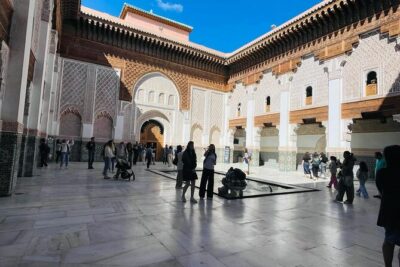
Bahia Palace, Madrasa Ben Youssef and Medina Tour
Read our review →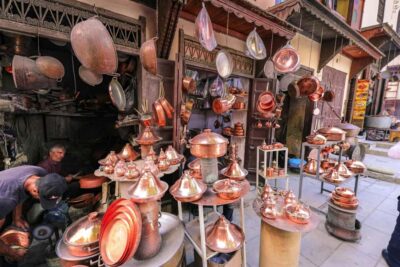
Explore Fes: Unforgettable Guided Walking Tour of the Medina
Read our review →
Madrassa Ben Youssef, Secret Garden & Medina Tour
Read our review →Browse the lists this tour appears in