
Reviewed · 7-DAY EXPERIENCES
7-Day Imperial Cities – Private Group
Morocco packs a lot into this seven-day circuit: a grand mosque by the Atlantic, Roman ruins, royal cities, maze-like medinas, and Marrakech after dark. The best feature is the private transportation and guide support, which keeps you from having to sort out long train rides, city transfers, and local guides on your own.
I like the mix of major sights and free time. You get Hassan II Mosque, Volubilis, Meknes, Fez, Bahia Palace, and Jemaa el-Fnaa, but you also have a full day to choose a museum, hammam, or café. The main drawback is the pace: Fez to Marrakech takes about seven hours, so this is a packed introduction rather than a slow, leisurely stay in each city.
In This Review
- Key points to know before booking
- Why this Moroccan circuit works
- Day 1: Hassan II Mosque and Rabat’s unfinished tower
- Day 2: Roman Volubilis and the royal ambition of Meknes
- Day 3: Fez, from the royal palace to the old medina
- Day 4: The long road south to Marrakech
- Day 5: Koutoubia, Bahia Palace, and the Marrakech medina
- Day 6: Your own Marrakech choices
- Day 7: Returning to Casablanca
- Accommodation, meals, and transport value
- Who will get the most from this tour
- Booking advice and final verdict
- FAQ
- How long is the Imperial Cities tour?
- Which Moroccan cities are included?
- Is transportation included?
- What accommodation is included?
- Are meals included?
- What is the maximum group size?
- Can I cancel for a full refund?
Key points to know before booking
- Four imperial cities in one route: Visit Rabat, Fez, Meknes, and Marrakech, with Casablanca at both ends.
- A private group of up to 14: Your group travels together, with a minimum of two people required to book.
- Strong guide support: Drivers and guides such as Omar, Ibrahim, Hassan, Kalid, and Noureddine have been associated with past departures, though your assigned team may differ.
- Roman ruins and Moroccan architecture: Volubilis gives the trip an ancient-world stop between the modern cities.
- Six nights included: Accommodation is based on double occupancy, with six breakfasts, lunch, bottled water, taxes, and listed activities included.
- Built-in flexibility: You can adjust the pace each day, and Day 6 in Marrakech is left open for your own plans.
Why this Moroccan circuit works
I see this tour as a useful first look at Morocco for someone who wants variety without managing every moving part. The route links the country’s best-known historic cities, and the private format gives you more control than a large coach tour.
Your driver meets you at the airport or hotel, then remains part of the trip as you move from Casablanca to Rabat, Fez, Meknes, and Marrakech before returning to Casablanca. That continuity matters. You can ask about local customs, stop to adjust the day, and avoid arranging a new taxi or transfer every morning.
The guide setup may vary. Some departures use one driver-guide throughout, while others connect you with local city guides. Past bookings have included guides and drivers named Omar, Ibrahim, Hassan Amraoui, Kalid, and Noureddine. The strongest praise has focused on drivers who did more than handle the road. They helped coordinate arrivals, contacted accommodations, explained the country between stops, and made the week feel organized.
At $1,485 per person, the price is not a budget backpacker deal, but it covers a fair amount: six nights, private transport, a professional guide, breakfast each morning, lunch, bottled water, entry to listed attractions, activities, and taxes and fees. The value improves for couples, families, or friends who want a private vehicle and a single arrangement instead of booking hotels, transfers, and guides separately.
You still need money for most meals and drinks, optional entries, shopping, and personal expenses. The price also assumes double occupancy, so solo guests should confirm how the room arrangement affects the final cost.
More Casablanca trips worth a second look
- 7 Days Luxury Desert Tour From Casablanca to Marrakech via fez -Camel trekking
★ 5.0 · 146 reviews - 7 Days / 6 Nights Private Morocco Tour from Casablanca or Rabat
★ 5.0 · 34 reviews - 7 Days Discovery The Atlas Mountains & Luxury Sahara Desert From Casablanca
★ 5.0 · 20 reviews
Day 1: Hassan II Mosque and Rabat’s unfinished tower
The tour begins in Casablanca with airport or hotel pickup. The first major stop is Hassan II Mosque, a striking modern religious complex on the Atlantic coast. Non-Muslim visitors are allowed inside, which makes it one of the most accessible major mosques in Morocco for international sightseers.
The scale is the point. The mosque can hold up to 105,000 people for prayer, and hundreds of Moroccan craftsmen worked on its decoration and construction. Give yourself time to look closely at the tilework, carved surfaces, and architectural details rather than treating it as a quick photo stop. The planned three-hour visit gives the day room to breathe.
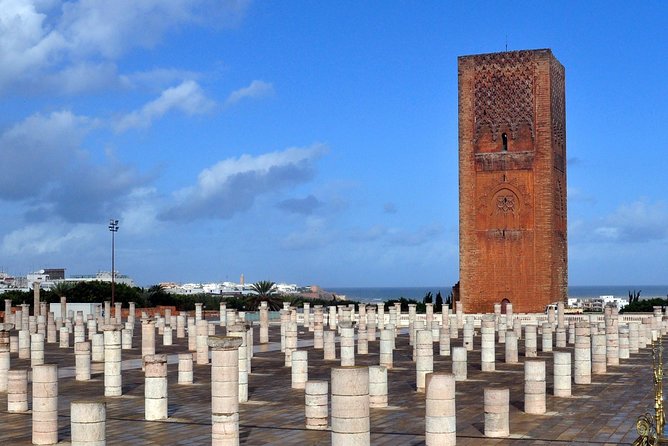
From Casablanca, you continue to Rabat. Hassan Tower is an unusual sight because its unfinished state is the story. Sultan Abu Yusuf Yaqub al-Mansur intended it to be the minaret of what would have been the world’s largest mosque. After his death in 1199, the work stopped, leaving the 140-foot tower, partial walls, and rows of columns.
Across from the tower, Mohammed V Mausoleum adds a more finished expression of Moroccan design. Its white exterior and green tiled roof are easy to recognize, and it contains the tombs of Mohammed V, Hassan II, and Prince Abdallah.
Day 1 gives you two different introductions to Morocco: a modern national landmark in Casablanca and a medieval royal project in Rabat. It is also a fairly gentle start, though you should expect a full sightseeing day after a flight.
Day 2: Roman Volubilis and the royal ambition of Meknes
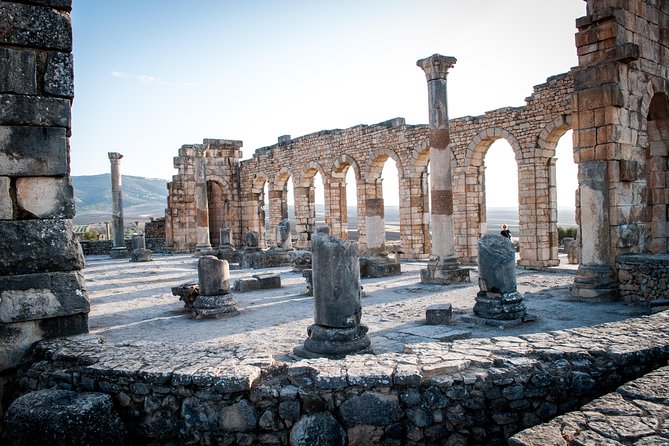
The morning drive from Rabat to Volubilis shifts the trip from Moroccan dynasties to Roman North Africa. The site dates to the third century BCE, when it served as the capital of Mauretania. Roman control began in the first century CE and lasted until the area fell to local tribes in 285.
Volubilis is especially worthwhile for its mosaics. Several floors remain in place, and their colors can look stronger when wet. The site is still being excavated, so you see both exposed structures and areas where archaeologists continue to work. A guided visit helps connect the scattered columns, arch, rooms, and mosaic scenes into a picture of an ancient settlement.
Allow about three hours here. The ruins are outdoors, so the experience depends on the weather and your comfort with walking across an open archaeological site. Wear practical shoes and bring water, even though bottled water is included during the tour.
Meknes follows Volubilis. It served as Morocco’s capital under Sultan Moulay Ismail from 1672 to 1727. The city’s grand scale reflects his ambition, and Bab Mansour is the clearest symbol of it. Its marble columns were taken from nearby Volubilis, an architectural detail that links the two stops in a very literal way.
The Royal Stables once held 12,000 horses, each assigned a groom and a slave. The size of the complex helps explain how the sultan’s court operated, but it also gives the visit a difficult human context. The Mausoleum of Moulay Ismail is one of only three active Moroccan shrines that non-Muslims may enter, making it a valuable cultural stop as well as a royal monument.
You finish the day in Fez. This is a full transfer and sightseeing day, so do not expect much unplanned time in the evening.
Day 3: Fez, from the royal palace to the old medina
Fez receives the most focused city touring on the route, with about eight hours and a private guide. The day combines short vehicle transfers with substantial walking, especially once you enter the old medina.
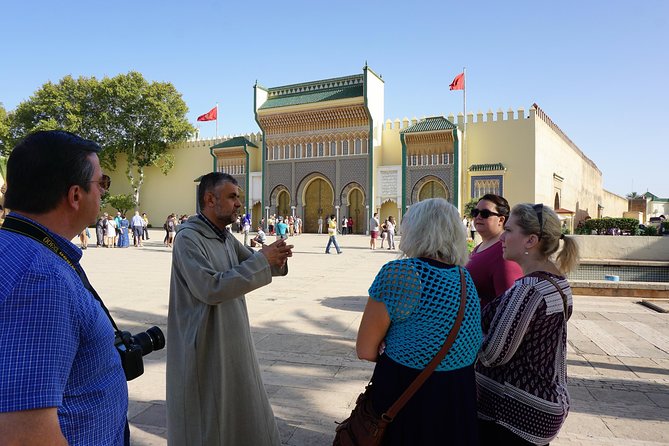
Start at the royal palace, known for its seven golden doors. You cannot treat the doors as an invitation inside, but the exterior gives your guide a chance to explain the decorative patterns and the palace’s place in the city.
The Mellah, or Jewish quarter, sits beside the palace. Its location was meant to provide protection, and the area adds a different layer to Fez’s religious and social story. This is one of the stops that benefits from explanation because the street layout alone does not tell you why the quarter was built there.
At Borj Sud, a former fortress on a hill, you get a broad view over Fez. This is a smart stop early in the city visit. From above, you can pick out landmarks that disappear behind the dense buildings of the old city.
The pottery cooperative offers a hands-on look at local craft. You can watch Moroccan pottery being made and see the detailed mosaic work used across the country. It is also a shopping stop, so keep your buying decisions clear. The tour gives you access to the craft process, but you are not required to purchase anything.
The old medina is the heart of the day. Expect narrow lanes, workshops, markets, religious buildings, and constant visual detail. A local guide is particularly useful here because the streets can be confusing, and the value of the visit is not only in seeing the sights. It is in understanding how the city functions.
Fez can feel intense. The long walking day, uneven surfaces, and crowded lanes may test your energy. The private format helps because you can discuss your pace with the guide, but this is still the tour’s most demanding day for anyone who dislikes extended walking.
A different kind of day out, same corner of Morocco:
- From Marrakech: Casablanca Tour with Hassan II Mosque Visit
★ 4.7 · 4,756 reviews - Casablanca: Hassan II Mosque Premium Tour with Entry Ticket
★ 4.5 · 2,971 reviews - Casablanca City Tour with Hassan II mosque ticket
★ 5.0 · 2,480 reviews - Casablanca: City Tour with Hassan II Mosque Entry Ticket
★ 4.6 · 1,137 reviews
Day 4: The long road south to Marrakech
Day 4 is mainly a transfer day. You leave Fez in the morning and travel by highway to Marrakech, with about seven hours planned for the journey.
The itinerary allows an optional stop in Rabat for lunch and a little sightseeing, possibly at the Kasbah Oudayah. That stop requires an extra entrance fee and should be discussed with your guide, especially if you prefer to reach Marrakech earlier.
The long drive is the clearest tradeoff in this itinerary. It lets you cover two major Moroccan regions in one week, but it leaves limited time for spontaneous stops. If you are happiest when every day contains several monuments, the road is part of the bargain. If you prefer slow travel, this day may feel tiring.
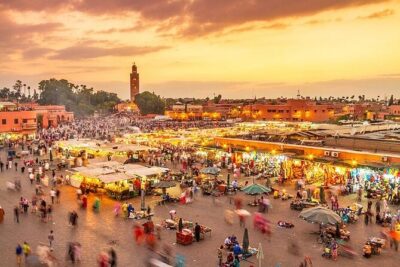
You arrive in Marrakech in the afternoon or early evening and check into a riad in the medina. A riad stay places you near the old city’s lanes and markets, although access by vehicle can be limited in medina areas. After settling in, visit Jemaa el-Fnaa as the sun goes down.
The square changes character in the evening, with street performers and food stalls bringing it to life. Stay alert to your belongings and agree on a meeting point if your group separates. The square is best enjoyed with curiosity and a little patience. It can be noisy and crowded, but that energy is part of Marrakech’s appeal.
Day 5: Koutoubia, Bahia Palace, and the Marrakech medina
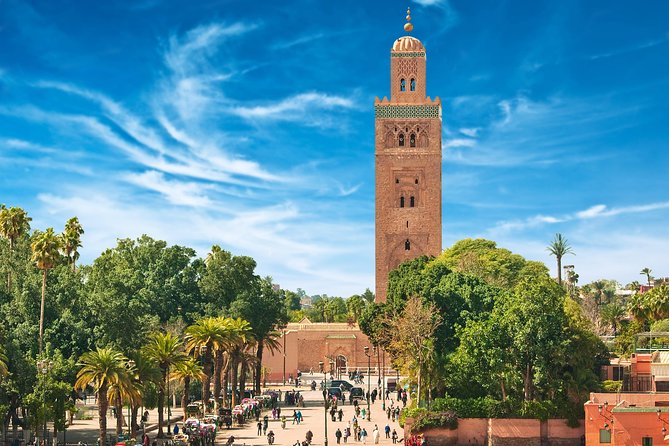
Your guided Marrakech tour begins at Jemaa el-Fnaa and continues to the Koutoubia minaret. At 253 feet, it is the tallest minaret in Marrakech, and city rules prevent buildings within the walls from rising above it. This gives the skyline a strong visual anchor.
The Berber apothecary is a practical stop rather than a postcard scene. You learn how spices and herbs are used in Moroccan traditional treatments. The focus is more educational than decorative, so it is a good place to ask questions and compare products carefully before buying.
Bahia Palace offers a different kind of beauty. Built in the late nineteenth century for a grand vizier, it was named for his favorite wife. The rooms and gardens cover about two acres, and the palace shows how power, family life, decoration, and courtly space came together in one complex.
The day lasts about six hours, which leaves some room afterward. That is useful in Marrakech because the city rewards unplanned wandering. You might return to the souks, sit at a café, or revisit Jemaa el-Fnaa when you know the layout better.
Admission to the main listed sights is included, but ask your guide what is covered before adding optional stops. Marrakech has many paid museums and gardens, and those costs are separate.
Day 6: Your own Marrakech choices
A full free day is one of the smartest parts of this trip. After several guided touring days and a long transfer, you can set the pace yourself.
The Yves Saint Laurent Museum, Berber Museum, and Majorelle Garden are listed options. The garden and museum require an entrance fee, so plan for those costs separately. This is the day to choose one or two attractions instead of trying to collect every sight.
You might also book a traditional hammam. The treatment described here includes black beldi soap, a scrub with a rough kessar mit, and time in a steam room. It is a more physical experience than a standard spa visit, so ask questions about the process before committing.
Or keep it simple. Walk through the souks, watch daily life from a street-side café, and use the day to shop without a guide urging you onward. I like having this breathing room because it makes the tour feel less like a checklist.
Day 7: Returning to Casablanca
After breakfast, you return to Casablanca for your departure flight. The transfer takes about three hours, so your flight time matters. Confirm the pickup plan and allow enough room for the drive and airport procedures.
This final day is functional rather than scenic. If your flight leaves early, ask how breakfast and transport will work. If you have a later departure, you may have some time in Casablanca, but the provided plan only promises the return transfer.
Accommodation, meals, and transport value
Six nights of accommodation are included, based on double occupancy. The Marrakech stay is specified as a riad in the medina, while the other lodging details are not provided, so ask about the exact properties before booking if room style matters to you.
Breakfast is included on all six mornings, and lunch is included as well. Most other food and drinks are not included. That gives you room to choose your own dinners, but it also means the final cost will be higher than the advertised price.
Private transportation is the backbone of the trip. You do not need to arrange the airport pickup, city transfers, or the return to Casablanca. Bottled water is included, and all taxes, fees, and handling charges are covered.
The group limit is 14 people, but the tour is private, meaning only your booking group participates. That distinction matters. You may have a group of two, a family of six, or a larger party, but you are not sharing the itinerary with unrelated passengers.
Who will get the most from this tour
I would choose this trip if you want a guided introduction to Morocco and value convenience over a slow, independent route. It fits couples, families, friends, and small groups who want one company handling transport, lodging, and local guiding.
It also suits people who want a flexible private format. Past departures have included families with children and a traveler using a wheelchair, with the team adapting the arrangements. Still, the itinerary includes extended walking in Fez and busy medina areas, so discuss your mobility needs before booking rather than assuming every stop will be easy.
Children must be accompanied by an adult and share a room with an adult or youth. Most people can participate, but the long drive between Fez and Marrakech and the walking in old cities deserve honest consideration.
This is not the right choice if the Sahara desert is your main goal. The route includes the imperial cities, Volubilis, Casablanca, and Marrakech, but no desert excursion is part of the stated seven-day plan. Some past custom trips connected with the same company included places such as Merzouga, Agafay, or Essaouira, but you should not assume those are included here.
Booking advice and final verdict
Book this tour if you want Morocco’s biggest cultural landmarks in one organized week, with a private vehicle, a continuing driver-guide, and enough flexibility to adjust the day. The strongest reason to choose it is the human support: drivers such as Omar, Ibrahim, Kalid, Hassan Amraoui, and Noureddine have been praised for being careful, friendly, organized, and willing to help beyond simply driving.
Skip it if you need long stays in each city, dislike road transfers, or want a desert camp included. The route moves quickly, and Day 4 is a serious stretch of highway.
For most first-time visitors with seven days, I think the $1,485 price can be good value, especially when shared by two people. Confirm the accommodation, meal details, assigned guide, optional entrance fees, and airport timing before paying. Cancellation is simple only if you act early: cancel at least three full days before the start time for a full refund.
FAQ
How long is the Imperial Cities tour?
The tour lasts approximately seven days, beginning in Casablanca and returning there on Day 7 for your departure flight.
Which Moroccan cities are included?
The route includes Casablanca, Rabat, Fez, Meknes, and Marrakech. It also includes Volubilis, the Roman archaeological site near Meknes.
Is transportation included?
Yes. Private transportation is included, along with a driver or guide, airport or hotel pickup, bottled water, and the return transfer to Casablanca.
What accommodation is included?
Six nights of accommodation are included based on double occupancy. The Marrakech stay is in a riad in the medina. Exact properties are not specified in the supplied information.
Are meals included?
Six breakfasts and lunch are included. Other food and drinks are not included unless specifically stated.
What is the maximum group size?
A maximum of 14 people can participate in one booking. The activity is private, so only your own group takes part. At least two travelers are required per booking.
Can I cancel for a full refund?
Yes, if you cancel at least three full days before the experience start time. Cancellations or changes made less than three full days in advance are not accepted for a refund.
Recently reviewed around Casablanca
- Casablanca Airport Transfer from hotel in Casablanca★ 5.0 · 18 reviews
- Amazing airport pickup/ drop off in Casablanca/ safe&easy★ 5.0 · 218 reviews
- Your Private Casablanca Transfer★ 5.0 · 52 reviews
- Chefchaouen the Blue City Full-Day Trip from Casablanca★ 4.5 · 79 reviews
- Sunset Camel Ride in the Palm Grove Of Marrakech★ 5.0 · 34 reviews
- Exclusive tour of Casablanca with access to the Hassan II Mosque★ 5.0 · 205 reviews
- Marrakeck City tour from Casablanca all the day around trip★ 5.0 · 35 reviews
- Private full day trip to chefchaouen from Casablanca with lunch★ 5.0 · 20 reviews
7-Day Experiences, compared.
7 Days Luxury Desert Tour From Casablanca to Marrakech via fez -Camel trekking
Read our review →
7 Days / 6 Nights Private Morocco Tour from Casablanca or Rabat
Read our review →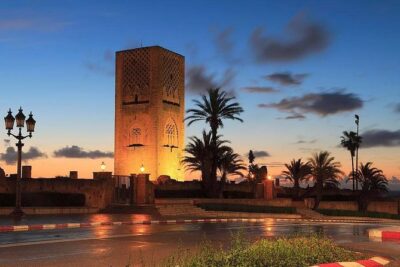
7 Days Discovery The Atlas Mountains & Luxury Sahara Desert From Casablanca
Read our review →Browse the lists this tour appears in